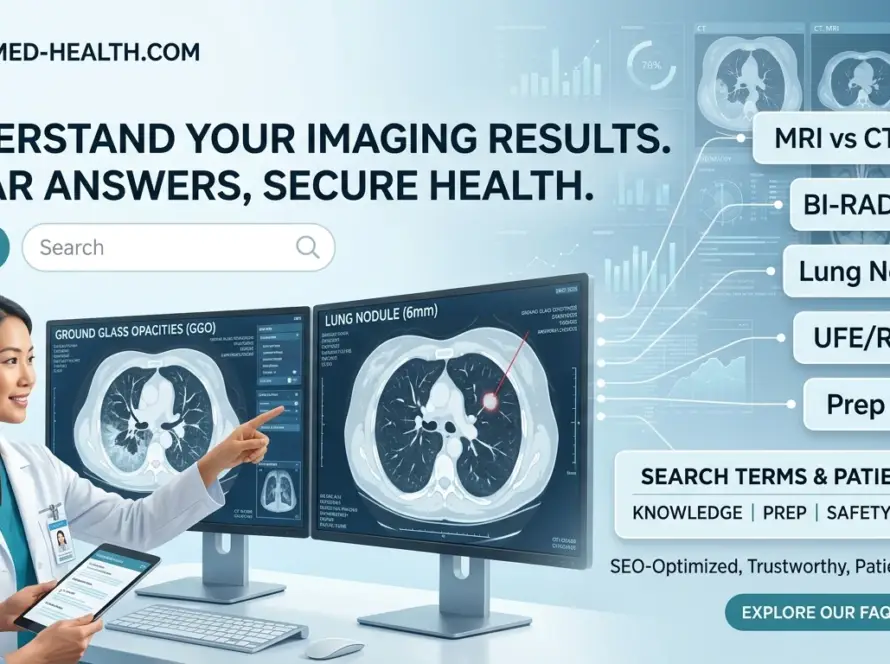
AI in Radiology: What Patients Should Know
Somewhere between the scanner and your report, software may have flagged a spot the size of a pinhead. Artificial intelligence has quietly joined the radiology team — here is what it does, and what it does not do.
AI in radiology is software that assists — never replaces — radiologists: flagging suspicious areas, measuring changes too subtle for eyes, and speeding routine work. Every image is still read and signed by a human physician. AI excels at pattern detection in mammography, lung CT, and fracture X-rays, but it can miss what it was not trained on and over-flag what it was. It is a powerful second set of eyes with well-defined limits.
How is AI actually used in radiology today?
- Detection assistance: highlighting possible lung nodules on CT, microcalcifications on mammography, bleeds on brain scans
- Prioritization: moving critical scans — strokes, clots — to the top of reading queues so emergencies jump every queue
- Measurement: tracking tumor size changes across scans with precision beyond casual eyeballing
- Workflow: protocol selection, image quality checks, and automating routine documentation
Does a computer read my scan instead of a doctor?
No. AI tools mark, measure, and prioritize — they do not diagnose, and they do not sign reports. Every study is interpreted by a radiologist whose name and medical license sit on the report. AI output is advisory input, the way a smoke alarm is input to a firefighter: useful, loud, and never the decision itself.
Where does AI help most — and where does it fall short?
Strengths: tireless consistency on high-volume screening (mammography, lung CT), detecting patterns at the edge of human perception, and speed. Limits: it can only find what it was trained to find; unusual presentations, complex multi-organ contexts, and image artifacts routinely trip it. False positives send patients toward unnecessary follow-ups; false negatives hand out false reassurance. This is precisely why the human read remains mandatory.
What should patients ask about AI in their care?
- Does this facility use AI-assisted reading for my exam type?
- Is the AI FDA-cleared for this use?
- Who reviews AI-flagged findings — and how are disagreements between AI and radiologists handled?
- Will my report mention AI was used?
What is the future of AI in medical imaging?
Convergence, not replacement: AI handling ever more of the measurable and the routine, radiologists concentrating on the contextual and the complex — the same trajectory as autopilot and pilots. Studies repeatedly show the strongest performance comes from human-AI teams, each covering the other's blind spots. The signature on your report stays human for the foreseeable future.
Curious about the technology behind your scan?
Ask us — and ask your facility what tools they use.
Contact SATMED HealthFrequently asked questions about AI in radiology
Can AI miss a cancer on my scan?
Yes — AI is a screening aid, not a guarantee. Radiologists read everything independently; AI misses do not go unexamined, because the human review is complete, not spot-checked.
Has AI been approved for medical imaging?
Yes — many tools carry FDA clearance for specific uses like lung nodule detection. Clearance is narrow: a tool cleared for lung CT has no standing reading your brain MRI.
Will AI make radiology cheaper?
Potentially, by increasing throughput and catching disease earlier — though technology costs and defensive practices complicate the picture. Savings, if any, accrue slowly.
Should I be worried my scan was read by AI?
No — worried is the wrong frame; informed is better. AI assistance is associated with maintained or improved detection rates in several large studies when paired with radiologists.
Can I opt out of AI-assisted reading?
Rarely, since tools are embedded in radiologists' workflow rather than offered to patients directly — but you can always ask what was used and request a human-only second opinion.
Does AI replace the need for a second opinion?
No. Second opinions involve different human experts contextualizing your case; AI cannot supply the second human judgment that makes second opinions valuable.
How SATMED Health makes contrast imaging safer
If your exam includes contrast, the delivery equipment matters as much as the scanner. SATMED Health engineers the systems behind every injection.
Contrast injector systems built for controlled, consistent delivery — the right dose at the right moment, every time.
Learn more →Engineered syringes for smooth, low-pressure injections that reduce discomfort and protect the vessel at the IV site.
Learn more →Patient lines and accessories designed for safe, reliable contrast administration from injector to vein.
Learn more →Contrast management solutions that help departments prepare, verify, and track every dose before it reaches a patient.
Learn more →Keep reading
More free, clinician-reviewed guides from SATMED Health.
Sources
- American College of Radiology. ACR Accredited Facilities Database.
- RadiologyInfo.org (ACR · RSNA · ASRT). How to Read Your Chest X-ray Report.
- American College of Radiology. ACR Manual on Contrast Media — current edition.
Machines measure; humans judge
Browse more free imaging guides or reach out with any question.
Contact SATMED HealthMedical disclaimer: This article is for education only and is not medical advice, diagnosis, or treatment. Always follow the instructions of your imaging facility and your own physician. If you think you are having an emergency, call 911 (or your local emergency number) immediately.
Please note: SATMED Health is not a medical facility. Please contact your physician with specific medical questions or for a referral to a radiologist. To locate an accredited medical imaging provider in your community, search the ACR accredited facilities database. This website does not provide cost information; imaging costs vary by region.