The Report vs Your Doctor's Explanation: Why You Need Both
The radiologist writes for physicians; your doctor translates for you. The two documents describe the same reality in different languages — and the translation step is where misunderstanding hides.
The radiology report is the specialist's precise technical record — detailed, hedged, written for clinicians; your doctor's explanation is the contextual translation — filtered through your history, symptoms, and what the finding means for you specifically. Neither replaces the other: the report has detail your appointment lacks; the explanation has context the report cannot hold. Read both, together.
What does the radiology report contain that the conversation does not?
Everything the radiologist saw — the measurements, the comparison language, the negative findings ("no pulmonary embolism"), the hedges and probabilities. Reports describe anatomy exhaustively because they are the permanent legal and clinical record; your ten-minute appointment cannot replay forty minutes of image-reading. When your doctor says "the scan looked fine," the report may still contain a "probably benign nodule, follow-up recommended" that deserves its calendar — the detail lives in the document.
What does your doctor add that the report cannot?
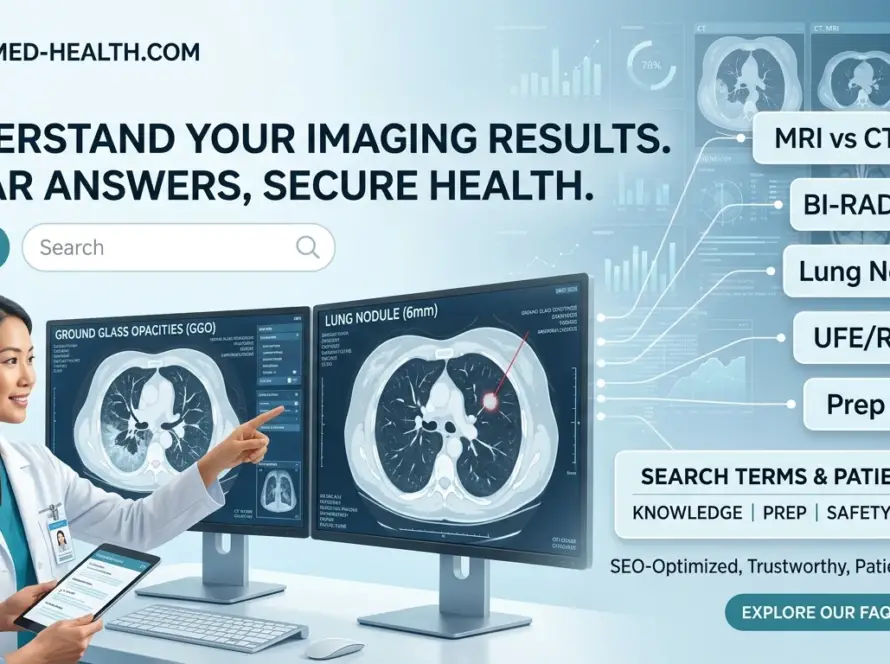
You. Your history, your examination, your blood tests, your symptoms — the context that converts a finding into a meaning. The same 6 mm lung nodule reads as "almost certainly nothing" in a 30-year-old nonsmoker and "needs attention" in a 70-year-old with a smoking history; the radiologist writes both reports almost identically, and your doctor supplies the difference. This is why "can't I just read the report?" has a real answer: you can, but the verdict is not in the report.
Why do the report and the explanation sometimes sound different?
- Selective emphasis: your doctor leads with what changes your care; the report lists everything it saw
- Translation lag: verbal summaries compress; details ("subcentimeter" versus "8 mm") blur
- Update windows: addendum reports arrive after your appointment — the file moved after the conversation
- Different worries: doctors answer the question they heard; reports answer the question that was asked
How to use both documents well?
- Get the report itself — portal, disc, or request; it is yours (our records guide)
- Read the impression first, with our report-reading guide open beside it
- Bring the report to your appointment — read the line, hear the translation, ask where they differ
- Note discrepancies explicitly: "The report says follow-up in 6 months — is that on our calendar?"
- Keep both forever: the report is the data; the explanation is the map; future care needs both
The questions that reconcile the two
- "What in this report matters most for me?" — the prioritization only your doctor can do
- "What did the report see that we did not discuss?" — the sweep that catches dropped follow-ups
- "If the report and your read ever disagree, which do we trust?" — usually the conversation, and a radiology review resolves true conflicts
Reconciling a report with what you heard?
Ask our team — then bring both to your doctor.
Contact SATMED HealthFrequently asked questions about reports and explanations
Is the radiology report the final answer?
It is the specialist record, not the verdict — your doctor adds the context that converts findings into meaning for you.
Can I rely on my doctor's summary alone?
For the headline, usually; for the details that schedule follow-ups, read the report itself.
Why does the report sound scarier than what my doctor said?
Radiologists describe exhaustively and hedge precisely; your doctor prioritizes and translates. Both are doing their jobs.
Should I read my report before the appointment?
Yes — arriving with the impression read and one written question measurably improves the visit.
What if the report and my doctor disagree?
Raise it — most conflicts are emphasis or timing; genuine conflicts get resolved with the radiologist or a second read.
Do I have a right to the report?
Yes — it is your record; portal access or a formal request gets it.
How SATMED Health makes contrast imaging safer
If your exam includes contrast, the delivery equipment matters as much as the scanner. SATMED Health engineers the systems behind every injection.
Contrast injector systems built for controlled, consistent delivery — the right dose at the right moment, every time.
Learn more →Engineered syringes for smooth, low-pressure injections that reduce discomfort and protect the vessel at the IV site.
Learn more →Patient lines and accessories designed for safe, reliable contrast administration from injector to vein.
Learn more →Contrast management solutions that help departments prepare, verify, and track every dose before it reaches a patient.
Learn more →Keep reading
More free, clinician-reviewed guides from SATMED Health.
Sources
- RadiologyInfo.org (ACR · RSNA · ASRT). How to Read Your Chest X-ray Report.
- American College of Radiology. ACR Accredited Facilities Database.
- American College of Radiology. ACR Manual on Contrast Media — current edition.
Data and map, kept together
Browse more free imaging guides or reach out with any question.
Contact SATMED HealthMedical disclaimer: This article is for education only and is not medical advice, diagnosis, or treatment. Always follow the instructions of your imaging facility and your own physician. If you think you are having an emergency, call 911 (or your local emergency number) immediately.
Please note: SATMED Health is not a medical facility. Please contact your physician with specific medical questions or for a referral to a radiologist. To locate an accredited medical imaging provider in your community, search the ACR accredited facilities database. This website does not provide cost information; imaging costs vary by region.